Community Learning Development Resource 603-03
EVALUATION IS A LEARNING EXPERIENCE
SUMMARY
This resource analyses evaluation as an experiential learning cycle. A fundamental concept of evaluation as experiential learning is that we have experiences of our work and in doing so we then seek to learn how to improve upon those experiences. Evaluation is explained as a dynamic complex of experiential learning processes where we purposefully seek to change our behaviour through learning from our practice.
1. Starting with the Experiential Learning Cycle

Commentary: if we are going to evaluate our work successfully we will need to put in place an effective set of processes, the use of which enables us to learn from each experience of our work and to improve on that experience. Our cycle of evaluation is the practical means by which we plan our work after evaluating and reviewing our previous work. This is a core component of our work practice. We should be proactive in learning to develop and improve both our understanding and our work practice, through organised evaluation, review and planning processes. Without effective evaluation, review and planning we become reactive or even unchanging – we are not learning from our experiences!
2. Putting the Evaluative processes into the Experiential Learning
Cycle model

3. The Evaluative/Experiential Learning Cycle applied to a new
experience – a briefing on Personalisation

Commentary:
- The evaluative processes are being applied here to a new experience, in that we have virtually no formal experience within our work of Personalisation and we have never tried to evaluate it in practice.
- We do not have an evaluative framework in place and criteria, targets, performance indicators and benchmarks that we can easily use to evaluate its worth and potential success. Our reflection will be about estimating rather than measuring. This is usually the case with new ideas and proposals for work practice. (Project Initiation).
- Our thinking will be much about developing our understanding of Personalisation as a possible additional area of work. We will realise what the initiative is about and begin to critical review its appropriateness and potential to be a successful strand in our work
- In our Experimenting, once we have concluded why we want to take on Personalisation, we will be planning what, how, where, by whom and by when we want to develop and deliver our Personalisation experience. This planning will include how we are going to evidence, evaluate and review that experience
- From start to finish the evaluative cycle will have been an overall learning experience for us, made up of a whole series of new experiences. If we take on Personalisation as a piece of work, our behaviour and that of our organisation will be changed.
- We intend through our planning that the new Personalisation experience that we provide for the people we work with, will be a good learning experience for them.
- We will learn whether or not we achieve successful outcomes outcomes, by applying our planned evaluation and review processes within our Personalisation project management and operation.
4. Other learning processes and connections in the Evaluative
Cycle approach to work practice
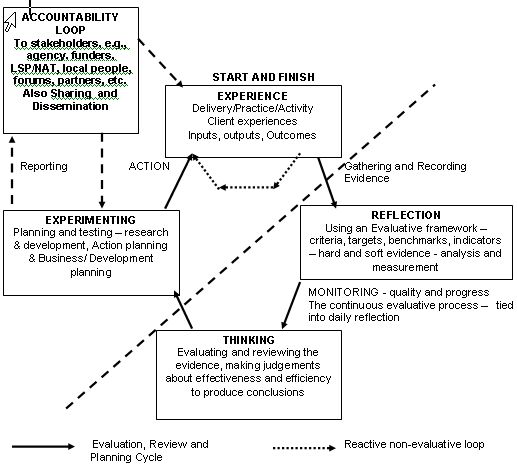
The processes of gathering and recording evidence are essential parts of daily practice and the requirement to organise reflective time. (Monitoring progress and quality)
The Accountability Loop, recognises that most of our work is not isolated and has stakeholders, who for various reasons have a vested interest in our evaluation of our experiences. (clients and local people/line-managers/agencies/funders/strategic bodies, etc.)