Community Learning Development Resource 602 – 11
THE CAPACITY BUILDING WORKER ROLE –
CHALLENGING OPPRESSION & DISCRIMINATION
SUMMARY
The ideas of equality, inclusion and valuing the individuality of learners are fundamental within adult learning and capacity building work.
Inequality and exclusion are problems and barriers, to be addressed and overcome through adult learning and capacity building.
This resource explores our understanding of the nature of inequality, and the implications for our development of effective and principled capacity building practice.
What factors lead people to discriminate? Ideas provided by workers at an Understanding Discrimination training event.
1. ATTITUDES
- A fundamental set of beliefs that affect our opinions and behaviour
- Opinions from the influences on our lives
- Attitudes are learned – influences of parents, peers, culture, society, religion, colleagues, role models
- Can be positive or negative, good or bad
- Developed by people conforming to the dominant culture in society
- Influenced by information and knowledge or by a lack of these
- Modified by past / life experiences
- Influenced by the media
- Shaped by peer pressure
- May become active as prejudices.
2. PREJUDICES
- Negative feelings about someone or something without foundation – non-acceptance of difference
- Opinions based on a lack of knowledge, lead to exclusion or inclusion of people
- To have preconceptions of individuals or groups – to pre-judge them
- Pressure to conform to biased views
- Prejudice comes through ignorance and a lack of understanding, intolerance and is negative, breeding contempt in people
- Prejudice is used as a mask for ignorance
- A lack of awareness and of respect for others, their individuality and differences
3. STEREOTYPES
- Images of people formed by influences on people’s thinking by parents, peers, culture, media and groups
- We categorise people – stereotypes, based on our own personal view of the world we see around us and its influence on our judgements
- Through our first impressions we categorise individuals to fit with our preconceived ideas, dislikes and opinions – usually negatively
- Oppressed and disadvantaged people may negatively self-stereotype – a ‘we can’t’ attitude
- Fashion dictates that: Punks are destructive / skinheads are hard / people with tattoos are aggressive / uneducated people are into street crime and vandalism
- Adverts target our own stereotypes
- Assumptions about people in groups or categories defined & reinforced by our prejudices
4. POWER
- The state or process of controlling others – individuals or groups, through position, status, money, law, representation, etc.
- Restricting the freedom of individuals or groups through domination and control.
THE LANGUAGE OF POWER :
Control Bosses Top-down Authority Decision-makers The law Aggression Rules Misuse of power Unequal
Manipulation Knowledge Politics Resources – ‘to have more’
Class Ability Luck Inequality Influence Confidence
Bullying Physical appearance and presence
|
5. DISCRIMINATION
- When the differences in society are highlighted by their inequalities and are acted upon in a negative manner through ignorance, fear, beliefs, attitudes, etc
- To make a judgement or action which adversely affects other people
- To have a negative attitude without understanding
- To treat unfairly
- An accumulation of attitudes, prejudices, stereotypes and oppression
- Not based on merit – based on experience
- Intentional and unintentional, institutional.
|
THE LANGUAGE OF DISCRIMINATION:
Differences Minorities Bias Beliefs Peculiarity Hate Ignorance Presumptions Uneducated Narrow-minded Unfairness Selfishness Power
|
6. OPPRESSION
- Restriction of freedom and liberty of an individual, group or groups of people
- Keeping people down / excluding people / denying opportunities
- Power through money, position, majority, information, education, access, language, communication, gender – enables some to limit the choice and power of others.
THE LANGUAGE OF OPPRESSION :
Manipulation Abuse of power Gate-keeping Denial of Rights Domination Opinionated Suppression Under the cosh Limited or no choices Under the thumb Control Holding people back
|
PROMPTS FOR REFLECTION AND DISCUSSION
- Are learners who are excluded – stereotyped?
- Are learners who are hard-to-reach – stereotyped?
- Are learners who are excluded – discriminated against?
- Are learners who are hard-to-reach – discriminated against?
- Are learners who are excluded – oppressed?
- Are learners who are hard-to-reach – oppressed?
If any of the above are held to be true, how does the situation manifest itself and what are the implications for the development of successful capacity building work by agencies, with these learners?
OPPRESSION IS :
- Stereotyping people
- Not listening to people and not taking account of people
- Putting people down e.g., – verbally; physically; as groups or individuals; through behaviour, body language – being condescending
- Denying access for people to – e.g., knowledge; information; facilities; education; jobs; housing
- Providing less or no support through systems or services
- The content and attitudes of some of the media
Intolerance – e.g.,
- of religious beliefs – not recognising holy-days, feast-days, festivals
- of people’s beliefs – e.g., in vegetarianism
- of people’s circumstances -e.g., being poor, unemployed, homeless, uneducated
- of peoples differences -e.g., race, colour, gender, age, youth, disability
Inequality within the law – specific legislation, e.g., in effect and practice –
- immigration law and it’s application
- arrest levels for black young people; patterns of vehicle stopping
Not valuing – opinions; culture; what people have to offer; learning achievements; potential
People in power deny – human rights; choice; votes; access; opportunities
Inadequate health care – minority groups are believed to be unhealthy, prone to disease, unclean,
- lack of care or resources for specific community illnesses
- lack of accessible information and opportunities for care
Capitalism – decisions about priorities; money and materialism; money and power; the rich few; inherited wealth; unfair distribution of wealth; cartels & monetary barriers
Class and conventions – the Establishment – professions; societies; clubs; class barriers
Education – the lack of multicultural approaches – e.g., in History and Geography
Employment inequalities – recruitment and selection procedures; promotion prospects; access to training.
INEQUALITY AND EXCLUSION
WHAT SHAPES THE INDIVIDUAL WORKER’S BEHAVIOUR
- Nature (skin colour) versus nurture (experience and learning)?
- Family, friends, peers, the older generation – role models and influence?
- Upbringing, dogma, culture, history, traditions and expectations?
- Changes in society and populations; communication; globalisation; cultural impact; changing opportunities; competition for jobs, houses, resources?
- Professional and contractual requirements and duties?
- Personal and professional tension – possible to have inconsistency and conflict within the individual?
LAW AND POLICY
The written word and the application in practice are not the same …
- Laws are framed in consultation to be enacted by the majority (the powerful?)
- Legislation is a mix of law and policy – influenced by lobbying and vested interest; political and resource constraints’ – at best ‘’a fudge’’, with areas of compromise
- The experience of law and policy, by the oppressed and a common opinion of the oppressed – weak, ineffective, incomplete.
WHEN THINKING BECOMES ACTION
Actions are oppressive and discriminatory (thinking is not) – behaviour through actions to –
- Ignore
- Exclude
- Label
- verbally abuse
- joke about
- put-down
- bully
- physically abuse.
Behaviour (Action) is controlled by:
- A sense of moral responsibility
- Contractual requirements
- Legal duties or constraints
FORMS OF DISCRIMINATION
- Direct – denial of service, rights, entitlement based in race, gender, disability, sexuality, age, etc.
- Indirect – imposing conditions which are unfair or not essential.
- Positive Action – allowed / encouraged by law – e.g., Genuine occupational Qualification
A STRATEGY FOR CHALLENGING DISCRIMINATION
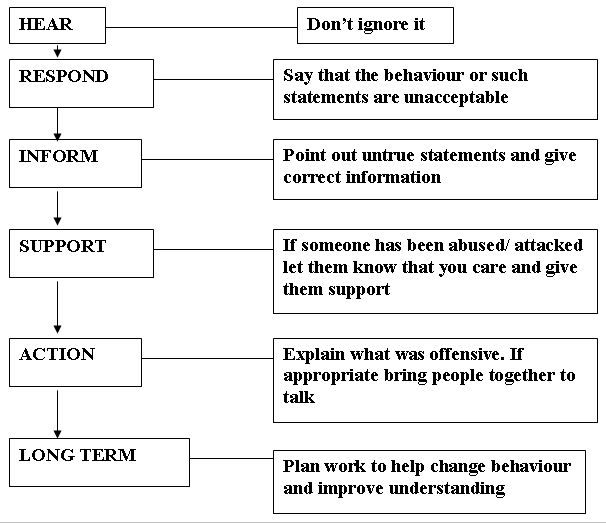
PERSONAL REFLECTION PROMPTS
- Have I gained a greater understanding of the issues and challenges of equality and inequality?
- Have I developed my understanding of discrimination and oppression in the context of power, gender, race, disability and sexuality?
- Have I gained a greater understanding of my own beliefs, attitudes and feelings in relation to equality and inequality?
- Have I gained confidence in my ability to address issues of discrimination and inequality in effective ways, in my work with people?
- I have become more confident to challenge issues of the inequality and oppression?
- Am I concerned to challenge inequality and oppression, and to support the oppressed?
- Have I gained knowledge of practical ways of exploring and challenging discrimination in my work with people?
- Do I feel less oppressed?
DISCRIMINATION AND OPPRESSION – REFLECTIONS BY A WORKER
Thinking and Action
- It can be argued that Attitudes, Prejudice and Stereotyping are parts of an individual’s thinking and might not become outwardly expressed as behaviour or actions. Within an individual’s thinking, they might not be detected by others.
- Discrimination and Oppression, need to be understood by us as being actions and part of outwardly expressed behaviour. Attitudes, prejudice and stereotyping can come to the surface in behaviour and actions and when they do they are aspects of discrimination and oppression.
- Attitudes and discrimination are also commonly used to identify ‘good’ or ‘positive’ thinking and behaviour, rather than ‘bad’ or ‘negative’. In our discussions we have concentrated on them as negative characteristics of inequality. It could be important to use the words positive or negative in relation to the terms, attitude and discrimination.
- Prejudice, stereotyping and oppression do not have positive interpretations.
Equality, Employment procedures and responsibilities of employees
- Individuals cannot be prosecuted for what they think, but can be for unlawful actions and behaviour. Disciplinary and/or dismissal procedures cannot be used against employees for what they think but can be for behaviour or actions which are unlawful or condone unlawful behaviour in situations for which they have the responsibility and authority as employees.
- Local authority policies are written in the context of the law. The local authority operates through policies and procedures – the written and the practice. Local authorities are very conscious of their responsibilities within the law, their public image and complaints against them. Disciplinary and dismissal procedures are lengthy and complex, but are also designed to protect the rights under law of the individual employee.
- The situations that employees find themselves in are very varied and it is recognised that sometimes they themselves are powerless and may be unable to manage or address unlawful actions or behaviour. They can only do their best to address inequality and take responsibility for their own actions.
Political correctness and nationalistic behaviour
- PC – this seems to have become a very tainted or negative concept, which is not good. The negative image of Political Correctness is painted by the majority, who have the power and capacity to discriminate against or oppress others. Being anti-political correctness has become a common excuse, particularly in the popular media, for not doing anything, not making changes and for maintaining existing oppressive power relationships.
- Equally the United Nations (Human Rights, etc.) and the European Parliament and European Law have in Britain can be viewed as the sources of ‘Political Correctness’ and as such to be resisted. Again the view of those who want the status quo and presumably the continuation of power relationships that include discrimination and oppression.
- Britain seems to have a history of bigoted independence (‘our little island’ / ‘this sovereign state’ / ’Brits’ /England– never mind aboutScotlandorWales, etc. – ‘theBritish Empire’). Is there a sense of pride or superiority within sectors of our society ?
- There may be a perception as a society and abroad, that Britain demonstrates more equality than almost any other country in the world – possibly so, but it doesn’t say much for humanity, if it is so. There is always room for improvement. The equality issue is not about broad standards or society as a whole, but more about individuals and relationships, and valuing diversity and difference. Is the UK multicultural – do we value and celebrate, the richness of cultures, cultural differences and multiculturalism?
Equality and Equality of Opportunity
- Equality is a broad inclusive concept and is about behaviour, relationships and people. Equality of Opportunity is a concept and a legal framework – an instrumental piece of legislation designed to make equality in principle happen in practice in our society.
- But Equality of Opportunity Policy or its basis in law does not include changing people’s thinking, beliefs and attitudes, etc., in how people relate to each other. Equality ofOpportunitymay enable people to be equally treated, have choices and achieve in terms of employment, education, health and welfare – but it doesn’t address relationship equality issues. It may enable the less powerful to gain access to opportunities but does not influence how others relate to them or treat them.
- Equality is about the thinking and behaviour of individuals, their responsibility for themselves and how they are in relationships and in society. It is about empowerment of individuals to be enable them to take control of their own lives and achieve their potential. It is about the lifting of oppression from the oppressed.