Community Learning Development Resource 500 – 07
THE PROFILE OF LEARNING WITHIN COMMUNITY DEVELOPMENT
SUMMARY
This resource explores the focus on learning as a core process within community development practice. Should we be concerned that in relation toUKcommunity development training and development requirements, defined by National Occupational Standards (NOS) in 2009, the importance of learning for beneficiaries within community development work may not be adequately recognised?
In community development practice:
- Is there an expectation that learning takes place within community development activity, where participants learn from their experience of participating in community development activity?
- Is it an assumption that all individuals in communities can be engaged with and potentially drawn into community development? Is little attention given to how to draw in those who are not ready, motivated or able to choose to participate – the ‘excluded’?
- Is there evidence that community development workers focus on those, in neighbourhoods and communities, who already ‘want to make a difference’ and have the capacity to do so – for example are ‘street leaders’ the first and last ‘port of call’?
- Is there little acknowledgement within Community Development of the need for individuals to ‘pre-build’ their own capacity in order to effectively engage in community development activity – the ‘excluded’?
- Is there an assumption that by simply being involved in community development activity, participating individuals will learn successfully and adequately to be empowered and motivated to change, to transfer their ability, to sustain and initiate other changes?
- Is there little evidence of concern for learning and learning opportunities equivalent to the pathways and progression routes which characterise ‘First-Steps learning’ within the community-based adult and community learning sector?
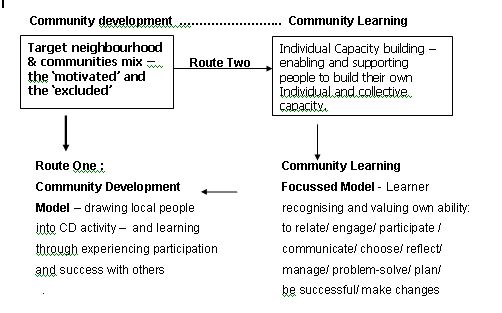
- With the Route One approach how do we ensure Equality as the core value in our practice?
- Might we be in danger of reinforcing exclusion by the empowerment of those already with some capacity to be included, responsive and recognised as having leadership potential?
- Are we driven by the need to evidence success in our practice to be superficial by engaging with softer targets?
- We know that empowerment can also build gate-keepers – are we in danger of doing this?
- If we enable those who respond to us to be our ‘ambassadors or champions’ are we ensuring that they adequately understand the nature of exclusion and oppression and seek to work inclusively?
The focus of the Community Development National Occupational Standards (2009) – is Route One the common Community Development model – with the focus is on simply engaging people in neighbourhood and community change?
The focus of Community Learning – Route Two – a learner focused model – takes longer and is about local people, becoming enabled to choose to engage effectively in change, as individuals, collectively and within communities.

THE FIVE VALUES OF COMMUNITY DEVELOPMENT PRACTICE ( National Occupational Standards October 2009) – the need for Learning and Individual Capacity Building
The need for the key values to be addressed – what about the hard to reach – non-self-referring – voiceless – excluded – disempowered – can the Community Development value set be held to be true in practice?
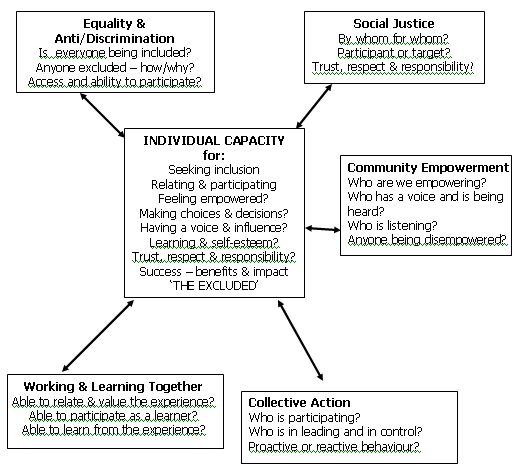
Within current Community Development training there is little recognition of the role of learning in enabling individuals to build their own capacity to engage.
Experiential learning may only be recognised in the context of group and organisational activity within community development and regeneration
Until those individuals, who are marginalised, oppressed and excluded, have the ability and capacity to choose to change their behaviour and their lives, they are likely to remain largely excluded within the context of community development and neighbourhood regeneration.
Without the ‘First-Steps’ learning stages and individual capacity building opportunities, which could access and enable less confident, inexperienced, non self-referring learners to participate effectively, Community Development and Neighbourhood Regeneration work could be judged to be exclusive, discriminatory and oppressive.
The Community Development NOS framework is prescriptive in relation to practitioner skills and practice, providing a comprehensive guide to ways of delivering effective community development and regeneration activities and outcomes. Community Development training programmes need a significant ‘community learning’ focus, which equip practitioners to take on board individual and collective capacity building and accesses them to relevant ‘teaching’ practice. (Appropriate and relevant in community learning situations). Such a curriculum does not easily cross-check with the Community Development NOS.