Community Learning Development Resource 102 – 06
USING THE HOLISTIC LEARNING OUTCOMES FRAMEWORK TO ASSESS CAPACITY BUILDING
SUMMARY
Assessing learning success and achievements within community learning and capacity building with concern for the holistic nature of learning – this resource reviews the use of the holistic learning outcomes framework in assessment which is fully learner-centred and empowering for t he individual learner.
THE HOLISTIC LEARNING OUTCOMES GRID
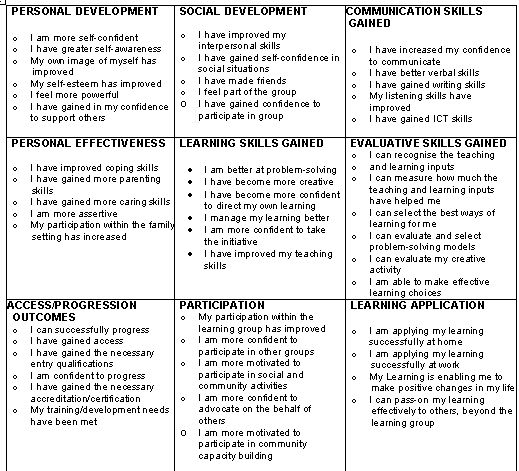
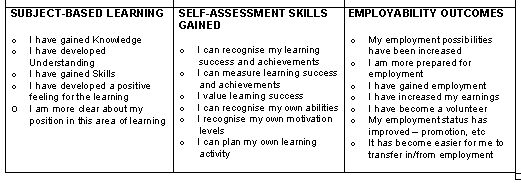
The grid on the next page identifies some of the learning outcomes we might associate with learning that builds individual and collective capacity. The focus is the ‘Holistic’ development of learners.
The questions in each grid square relate to an area of learning, but they are not a script. They are ideas and suggestions about the sort of learning outcomes you and an individual learner might choose to explore and assess. The challenges for you as the worker are:
- to consider which questions you think will evidence the learning that is relevant for the individual, and for you and your work, and how you will enable the individual to play an equal part in choosing and participating
- to think about the criteria by which the answers might be judged
- to think about what time, place, style and sensitivity will support the learner to answer effectively and gain from the assessment experience
- to think about the conversational language you will use – the learning outcomes grid language requires adapting to connect with the individual learner
ASSESSING LEARNING HOLISTICALLY – LISTENING TO LEARNERS
Some examples of learning outcomes and gains to explore with individual learners.
What we should really be trying to assess are the outcomes and effects of learning (gains, benefits and impact), such as:
- How has their learning benefited the learners?
- How has their learning made a difference in their lives?
- How has the application and use of their learning produced benefits for those around them?
- How has their learning enabled them to contribute to change and development (in themselves, their families, their neighbourhood, the community)
- What beneficial changes, improvements and developments can be traced back to their learning?
For this evidence we need to listen to learners and those around them and we need to connect with the situations where their learning is having an effect.
PROMPTS FOR REFLECTION AND DISCUSSION
- From your own experience, can you identify a set of learning outcomes within a piece of development work with an individual. Can you identify how you would assess the success of their learning?
- Recently a group of community workers talked about the importance of day-to-day recordings in order to capture learning success with individuals – why do you think this may be so and what is your experience?