Community Learning Development Resource 102 – 03
ASSESSMENT OF LEARNING – A UNIVERSAL MODEL
SUMMARY
This ‘Assessment Cycle’ models how learning may be assessed, and can be adapted and used within all learning situations and for any type of learning.
THE ASSESSMENT CYCLE
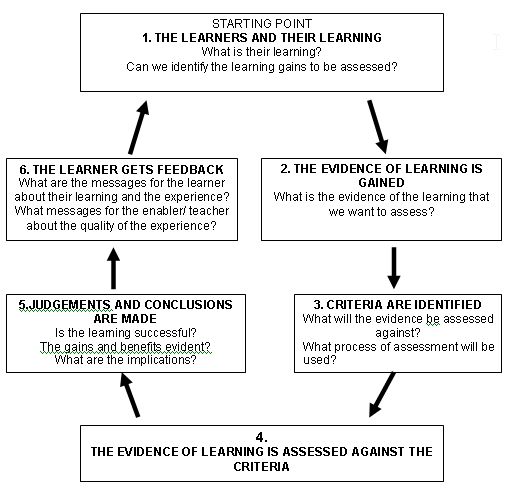
Observations about the assessment cycle:
- The model works for any kind of assessment process, ranging from having an informal chat with a learner about what they think they might have learned, to a public examination like GCSE
- It is a process which seeks to gain evidence of learning – that learning has been successful – that it has taken place or it is in place
- The model works when one person (the assessor) assesses the learning of or with someone else (the learner) and also when one person self-assesses their own learning
- Gaining the evidence of learning can be as simple as having a conversation and listening, asking a question or watching a learner
- The criteria may be written down as part of a learning programme, course or scheme of work but often they come from what the assessor understands and has experienced
- Moving from judgements to feedback is a crafted process, which:
- confirms and celebrates the learning success of the learner
- gives them ownership of the learning success
- enables them to understand the nature and the value of their learning success
- encourages them to move on and continue to learn
- also provides evidence for the assessor (worker) as to whether or not their efforts have been successful.
- When a course is being developed within Education and Training provision for adults, the design must include an Assessment Scheme, which will ensure that this contributes to any accreditation of the course.
- Many community-based learning opportunities are less formal, nevertheless, assessment of learning remains a key process, no matter how informal the organisation of the learning experience becomes.
- Within the wide range of learning in the community experiences, we often have to work out for ourselves how we, and our learners can assess the learning effectively.
- The challenge is to develop an assessment strategy, which is appropriate and sensitive to our particular learning situation and the learning, and to the needs of our learners. Our assessment startegy also needs to be seen as valid and effective by all stakeholders, including our learners and funders.
- The assessment cycle is a good model for us to use as we try to develop an appropriate assessment of learning strategy within our work.
PROMPTS FOR REFLECTION AND DISCUSSION:
- What are the merits of the learner assessing their own learning and are there any drawbacks?
- Within our own work what evidence of learning do we want to assess?
- Within our community learning work – what would we like our assessment style to be?