Community Learning Development Resource: 500 – 03
NEIGHBOURHOOD ACTION AND REGENERATION:
UNDERSTANDINGS AND MEANINGS
SUMMARY
This resource (500 – 03) reviews some concepts and the language commonly used within the practice of neighbourhood action and regeneration work.
1. REGENERATION – any activity, which engages people in developing and improving the quality of their experience of life in their neighbourhood or community.
- A Community Strategy within a local authority area in theUK, commonly has an agenda with a range of regeneration activity strands, which often include improving:
- local service delivery
- housing and the environment
- community safety, and reducing crime and disorder
- arts, culture, sport and leisure opportunities
- transport, and access to facilities and services
- health and welfare
- education and training opportunities
- economic well-being, employment opportunities and take-up and reduction of dependence of welfare and benefits. This last strand is frequently the core strand within any community improvement or development strategy.
- Some commonly occurring themes within the scope of Regeneration:
-
- community development
- community improvement
- community action
- community provision
- community capacity-building
- neighbourhood renewal
- urban and inner-city regeneration
- community consultation
- change activities below neighbourhood level – individual, family, etc.
1. The scope and power of regeneration

The term ‘regeneration’ in theUK, has also been used and understood more narrowly to mean only ’inner city development and improvement’. Similarly the term ‘renewal’ has come to be associated specifically with prioritised ‘neighbourhood renewal’.
Renewing, rekindling or reawakening the desire and motivation within individuals and communities, is a key part of any neighbourhood action or regeneration strategy, otherwise the model of working can become provision or service delivery only, encouraging dependence and little sustainability.
2. A CAPACITY FOR NEIGHBOURHOOD ACTION AND REGENERATION
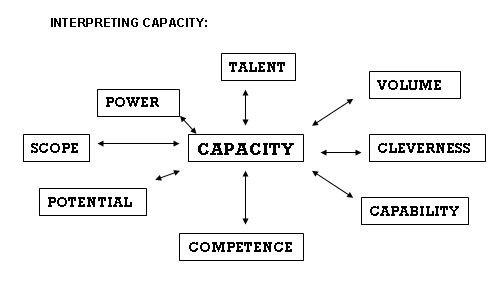
Capacity is the total resource within an individual, group, neighbourhood or community by which they can live, manage and change their lives.
There is an inter-connected and contributory relationship between three recognisable forms or levels of capacity within neighbourhoods, communities and society – the individual capacity enables a person to contribute to the collective capacity of a group, which in turn, can contribute to community capacity.
- Individual capacity – the skills, knowledge, abilities and feelings of an individual, which equip and enable them to function within their lives. Learning is the key process that changes people and builds their individual capacity, particularly through learning from experience.
Self-esteem, self-confidence, self-image, self-value, etc. are some indicators of the capacity of individuals – their power and how they feel about themselves. Capacity is not about what learning is put in place but more about how the learner is able to apply, use, benefit from, recognise and value their learning.
- Collective capacity – this is built-up by the gathering together of individuals who bring their own individual capacity, to contribute through their involvement and participation within a group – e.g., family and relations, friends , a group of neighbours, a community group. The learning from experience here is mainly about relationship-building, communication and the use of individual power. Where individual and collective capacity is directed towards neighbourhood action or regeneration, it becomes community capacity.
- Community capacity is crucial in directing, resourcing and achieving success through neighbourhood action and community development.
3. PARTICIPATION IS ABOUT TAKING-PART
- Participation implies active involvement. Those who participate are not just passive receivers of the experience – they interact with the situation.
- Individuals interact within collective experiences with other individuals
- Participation implies working together, partnership, equality, etc,
- Participation means ‘playing a part; playing a role; ‘get in on’; ‘have a hand in’
- For individuals to successfully participate they need to feel comfortable, have a ‘can-do’ attitude and feel-good about themselves – having adequate individual capacity.

4. THE LANGUAGE OF NEIGHBOURHOOD ACTION, COMMUNITY DEVELOPMENT AND COMMUNITY LEARNING.
- A Norm: a principle of correctness that is binding upon the members of a group and serves to regulate actions and judgements
- A Value: a moral principle or standard of behaviour
- A Principle: a universal or fundamental law, doctrine or truth. A rule or code of conduct. To behave on the basis of belief or moral code (being principled). Devotion to the rules of right conduct, morality, integrity(a tenet)
- A Mission: a specific task with which a group or person is charged
- A Vision: having a view of the future
- A Protocol: a code of conduct or procedure – a record of agreement through negotiation
- A Purpose: the reason or intention underlying action
- The Philosophy: sum of beliefs and attitudes of an individual or group
- A Belief: conviction of the truth of something – a principle or collection of principles held by an individual or a group
- A Culture: the conditions, which inform and shape the behaviour of individuals, groups and organisations.