Community Learning Development Resource 501 – 02
A FRAMEWORK FOR EXPLORING AND DEVELOPING
LEARNING STRATEGIES AND INTERVENTIONS
SUMMARY
Planning for community learning and community development interventions can take on board at least three major drivers – learner needs and wants; mission, principles and practice of the workers and agencies; strategic targets from funding and governance bodies. This resource (501-02) suggests a framework, for looking at the different drivers.
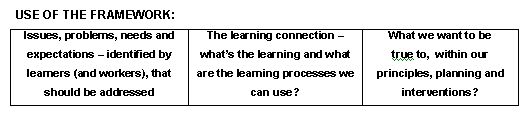
Planning community learning interventions with reference to three perspectives:
- From the learners’ perspective – listening to learners – what are the issues, problems, needs and expectations, that they want us to take on board & work with?
- From the agency, service, worker’s perspective – what are the principles/ values and purposes (goals & desired outcomes) on the agency & worker agenda.
1. What values and principles and priorities do we want to be true to?
2. What do we want to achieve, within our planning and interventions?
- Strategic targets and requirements – what are we tasked to achieve by any local/national strategy, our funders, partners or responsible bodies?
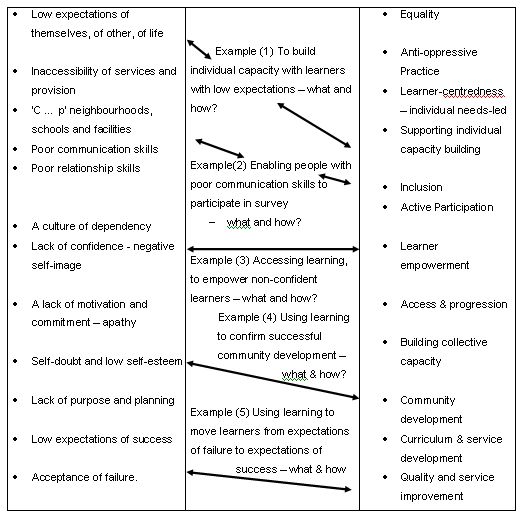
The intervention interface is the arena in which the perspectives come together – where learning interventions are delivered and solutions need to be found which through learning engagements, will address the learners’ needs etc., and deliver the outcomes that the service, etc., desire in ways that are appropriate. We need to find the learning and learning processes we can use successfully?
(The example of use of the framework given below comes from work done with targeted social housing estates in two small East Midlands market towns)
Monitoring, evaluation and review – evidencing success
It is likely to be important to be able to evidence any success in addressing needs, wants and problems so that the evidence contributes to evaluation and review in relation to a Community Strategy or in response to governance or funding requirements. Returning to the social housing estate example , the ‘what and how’ of the learning and learning processes will need to supported by evidence which answers the questions – ‘how do you know’ and ‘by how much’ to evidence success, within a strategic framework. Such a framework might require evidence of successful learning and change in relation to a number of targets or task areas – for example:
- Active participation by local people within themes/ actions of the Community Strategy
- Local people responding to planning consultations and surveys
- Environmental improvements
- Community safety improvements
- Improved access to services
- Improved Health
- Improved take-up of Education and Training
- Provision for Young People developed
The framework is a practical tool that enables us to take on the one hand, our findings from surveying, questioning, consultation and listening to people and on the other hand the purposes values, plans and methodology of our practice, for us to work out learning pathways that will connect the perspectives for successful outcomes.
The ‘Big Society’ has increasingly demanded the attention of agencies and workers as the Coalition Government thinking becomes a driver and funding stream for community development initiatives and practice. Some practitioners are wary of the ‘Big Society’ agenda and have concerns for its intentions regarding disadvantaged and vulnerable people in society – how can the different drivers of local needs, practice values and ‘Big Society’ requirements be effectively combined for success?