Community Learning Development Resource 401 – 09
INDIVIDUAL AND COMMUNITY CAPACITY BUILDING
SUMMARY
Understanding a learning and community development connection
A SCENARIO – THE GENERAL ELECTION
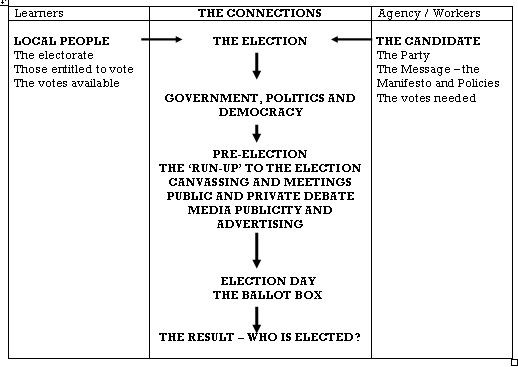
The general election is a piece of community development or regeneration. The election determines the nature of the political will and power, which will govern the country and affect the lives of people, neighbourhoods and communities, until the next election.
The election is about people choosing their representatives and their Government. The election process needs the Voter to make two key choices – to choose whether to vote or not and who to vote for. A Candidate needs to persuade people to choose to vote for her/him and to do so.
Learning is at the core of the election process.
Participating in the process, deciding to vote, choosing a candidate to vote for and putting a cross on a voting slip or postal ballot, are all learnt behaviours. This learning is largely about the personal development of the learner – building their individual capacity to participate, by which they contribute to community capacity building and community development by choosing to vote in the democratic/political process and help shape power and policy.
On the other side of the Ballot Box the Candidates and Parties have a learning agenda, which seeks to reinforce or change individual voters’ behaviour so that they vote for them.
There is a curriculum here, and whilst the learning content (the messages) and the learning approaches (how to put the messages across) are concerns, the most important concern is how to connect successfully with individual learners.
The learning approaches tend to be informal or non-formal – on the doorstep, in the street, and with groups in the community, with a heavy dependency on the media, promotional materials and the use of communication and interpersonal skills.
The Model
The general election scenario is a model, of working with people in the community, within which learning is a significant process. It is also truly community-based learning model and a model for community development.
This model has wide application within work with people living in communities. There will be learning, when an agency has planned outcomes, which are about shaping life within neighbourhoods and communities and where there is an agenda to connect with or change the behaviour of people in the community.
Any strategy or action plan should prompt learning (a curriculum), which will encourage and enable local people to connect effectively with the agency and what it is seeking to do.
Reviewing the Model – some other applications
The learners |
THE (Learning) ARENA |
Responsibility for the Learning (curriculum) |
||||||
|
The local electorate
People in the Community
People in the Community
People in the Neighbourhood
People in the Community
People in the Community
|
The democratic process – the Election
Consultation about strategy and planning
Consultation about issues affecting the community
Inviting participation within a community strategy or action
Seeking to action a community plan in terms of neighbourhood level action (e.g., Regeneration & Renewal)
Seeking to gain evaluative feedback about the quality of services or provision
Seeking to build community capacity for self-sufficiency and sustainability
The Learning Arena
|
The candidate and political party
Local planning authority – Borough Council, PCT, etc.
Local Planning authority, Borough Council, LSP, Parish Council, etc.
Local Strategic Partnership/group
Local Strategic Partnership/group, lead officer/worker
Statutory or voluntary agency, lead officer, worker
Agency or worker
Agencies plan for and work in ways that enable and encourage learning – and effective participation by local people within strategies and actions. |
Are there examples of community development work where there might be no planned-for learning component?
Yes – if the agency, the decision-makers, or the workers simply wish to be powerful and to own and force what it is they seek to do on the community or neighbourhood, without any reference to the people who may be affected.
Yes – if the agency, the decision-makers, or the workers prefer to work with people, neighbourhoods and communities only through a provision model, without any attempt to build in community capacity, self-sufficiency or sustainability.
Yes – if the agency, the decision-makers, or the workers believe that they already have the right or a mandate, for example through an existing or previous democratic/political process, to make decisions and take actions on behalf of people, without further recourse to them.
Yes – if the agency, decision-makers, workers or people don’t believe in accountability; partnership; participation; listening, etc.
Yes – if equality and inclusion are not core values for any community development work, and local people are not encouraged, enabled or supported, to choose to build their own capacity to participate, and are thus excluded.
PROMPTS FOR REFLECTION AND DISCUSSION:
- Does every planned work outcome within community development work, where an agency or worker seeks to engage with people, have a significant learning component?
- There are many examples where the learning component has been diminished, because it has not been identified, understood or implemented effectively.
- There are many examples where year-on-year community development work has not moved beyond a service provision model, because there has been little learning and community capacity building for self-sufficiency or sustainability.