Community Learning Development Resource 401-02
CAPACITY BUILDING IN COMMUNITY DEVELOPMENT AND NEIGHBOURHOOD REGENERATION
SUMMARY
Modelling the strategy and processes, which put capacity building at the heart of community development and neighbourhood regeneration work.
A STRATEGY
There is a working relationship between a service, agency or worker, and local people which is inevitably two-way:
- The contact, promotion and delivery by workers
- The responses made by local people.
Community Development and Neighbourhood Regeneration
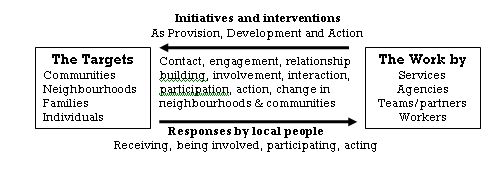
What are the ways of working and what might be anticipated as the responses?
- Are the workers engaged in provision – providing activities and services – where the local people are passive recipients of these – are they involved?
- Are the workers engaged in development activity – working with local people – in partnership to develop activities and services, improvements, etc. – are the people active recipients – do they actively participate?
- Are the workers encouraging local people to be proactive – to develop their own solutions – activities and services, improvements, etc. Are the people participating by leading and being in control – community action?
Why is learning important in your work?
If the success of your work depends upon your target group of people responding in some way they may need to change their behaviour in some way – to be able to respond and to choose to respond.
- Their learning needs are likely to be minimal if all your work requires is for them to be passive recipients – maybe they just need to learn to turn up and just watch and listen – a community provision model
- There may be more learning if your work requires that it is more actively received – maybe the work needs the recipients to generally react and choose to react in some way that benefits them.
Learning may play an even more significant part if your work requires that the recipients should act or choose to act individually in a new or different way – a community development model.
- The learning component is likely to be significant and essential if your work requires that the recipients change, so that they choose independently and individually to achieve intended outcomes (your work outcomes). – a community action model
If learning is to be part of the working relationship, then the needs and wants of people, the ways of working, the intended work outcomes and their impact, will all shape what the learning needs to be and how it should happen.
Building learning into the working relationship
- The nature of the working relationship may change, because within any learning relationship, feedback plays an essential part
- Within any learning relationship the development of role of the learner in that relationship, with equality and inclusion as the core values, becomes a key concern for the worker.
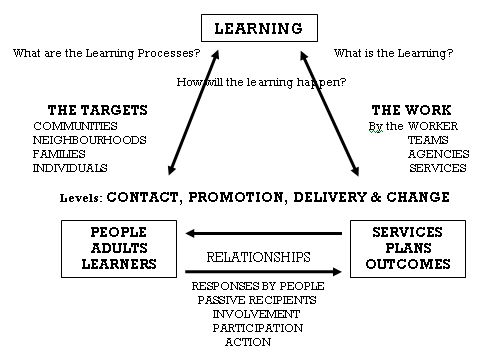
The Learning Journey and the Worker Role
The worker in enabling and supporting people to learn, has a teaching role but we need think beyond the formality of teaching within education and training, towards a more informal teaching role – that of a ‘facilitator of learning’ – an enabler, supporter, a coach – a Capacity Coaching role:
- Capacity coaching is more concerned with the growth of the individual both as a learner and as a person, rather than on the learning (subject matter) to be put in place, often the more common focus for teaching.
- Capacity coaching is about enabling and encouraging the individual to choose how to use and apply their learning, through enhancing their learning skills and their personal development.
- Capacity coaching is about building up the learning capacity of each individual learner and how this is transferred and applied within collective and community capacity building for change.
Within the capacity coaching learning route, the focus on the learner and on their development, rather than on the learning content, shapes and informs the choice of coaching methods and the learning activities and processes.
The changes and improvements, which are brought about by individuals and by groups of people, in their lives and in communities and neighbourhoods, we see as being within the broad field of community development and regeneration.
The learning journey for any learner engaged through capacity-coaching, starts from their starting point at entry, wherever that may be.
Through building them as learners (individual capacity-building) and a connection through bringing learners together (collective capacity-building), the learning journey continues, to become one involving the experience of using and applying the learning, in their contributions and participation in regeneration.
To this end the work of Local Strategic Partnerships and Community Strategies provides a framework for regeneration, and the purpose and context for many of the capacity-building learning journeys. If the purpose is improving community safety then the learning journeys are about empowering local people to be proactive in their neighbourhoods and communities in building community safety.
It is therefore also clear that Local Strategic Partnerships and their working groups and plans, should contribute to the shaping of the learning agenda and learning processes – a community learning curriculum.
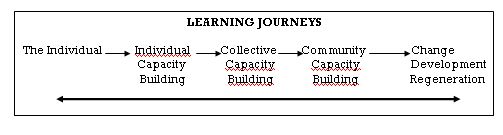
What is happening?
- Change through relationships between people – information-sharing; ideas; influence; motivation; becoming change-agents; empowerment
- Contributions within collective situations – with others, in neighbourhoods,
- Prompting, building and empowering collectives, groups, networks
- Impact and change through community action
- Benefits – for individuals, groups, neighbourhood, communities in services; developments; improvements; culture; regeneration and renewal.
PROMPTS FOR REFLECTION AND DISCUSSION
- How well does the Capacity Coaching learning model fit within the practice of workers, agencies and services?
- Is it agreed and understood that the relevant learning needs of people should to be at the core of regeneration strategies and plans?
- What might be the nature of a curriculum for community participation, within a strand of community development work, e.g. getting local people to actively and successfully engage in a community safety initiative or actively participate in running a community house.