Community Learning Development Resource 400 – 07
LEARNING WITH WORKERS IN COMMUNITIES AND NEIGHBOURHOODS
SUMMARY
It is evident that workers and agencies work with people in local communities and neighbourhoods, in a variety of ways where learning plays an important part in the engagement. This resource (400 – 07) identifies workers and the ways in which they find themselves engaging with people through forms of learning.
Forms of Learning
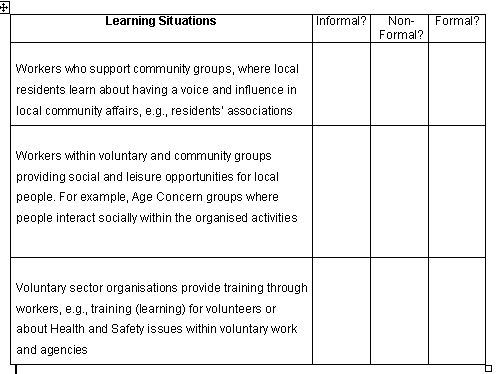
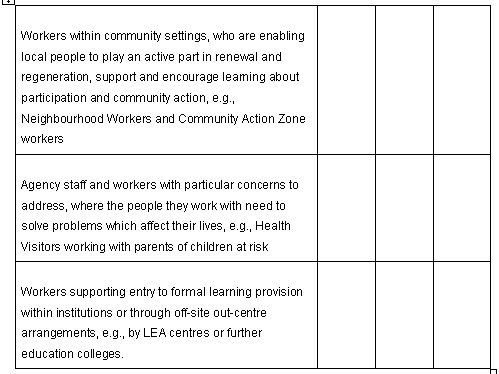
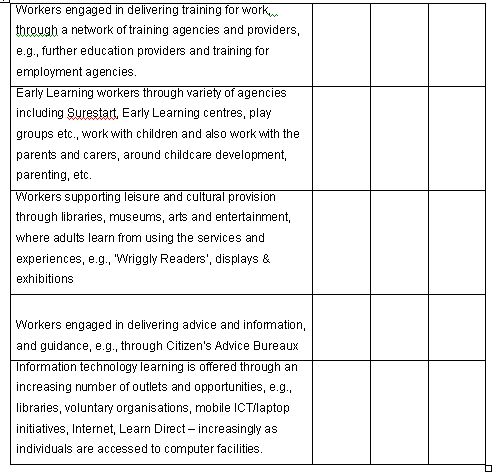
Three broad categories of learning situations are identified here:
- Informal Learning – the natural and universal day-to-day form of learning which occurs whenever there is a human interaction when connecting with others or from situations which are not planned to be learning experiences. Most people are unaware that they are learning in these circumstances and yet it is the commonest lifelong form of learning.
- Non-formal Learning – group situations not planned and declared to be learning experiences but where the collective nature of the experience, with social contact and communication, provides an environment where learning naturally occurs. Most people do not identify that they are learning in these circumstances, but may be aware that they are gaining something from being there.
- Formal Learning – planned for and declared purposeful learning situations, anticipated by the participants with expectations of learning something. These are the ‘bread and butter’ of education and training – classes, courses and programmes. These usually have a clear taught input, even if no human teacher is present (e.g., through learning on line).
There are no hard and fast boundaries between the categories and they can slip from one to the other with changes of communication style, culture and emphasis. For example a conversation (informal learning) can easily become a lecture (formal learning).
LEARNING SITUATIONS
The learning situation examples can be used to prompt identification of forms of learning and discussion of the implications for successful practice and outcomes.
PROMPTS FOR REFLECTION AND DISCUSSION
Workers, providers and agencies should be able to relate to examples in the table, and review how they operate and contribute:
- Are the learning situations in the list part of your work or that of your agency?
- Are the situations part of what you believe you will be doing in the future?
- What is the learning that you are concerned with – what do you hope that the people you work with will achieve?
- Are you are able to get a fix on your own contributions and map how these can relate to the contributions of others workers and agencies, in ways that make sensible supportive connections for learners?
- Is one of the challenges for workers and agencies, to ensure that individuals can gain from the variety of learning opportunities on offer, to be able to choose what, how and when they want to learn? Should choice be a fundamental entitlement for all individual adult learners?