Community Learning Development Resource 400 – 03
COMMUNITY LEARNING DEVELOPMENT MODELS
SUMMARY
Modelling how community development strategies might work in communities and neighbourhoods, with community learning for capacity building as a key process. This resource (400-03) presents the models as an aid to enabling workers and agencies to reflect on their organisation and practice.
The Models
The series of models build a picture of the crucial part that Learning plays within Community Development and Neighbourhood Regeneration work. In the models the common components are numbered across the series and each model comes with a storyline.
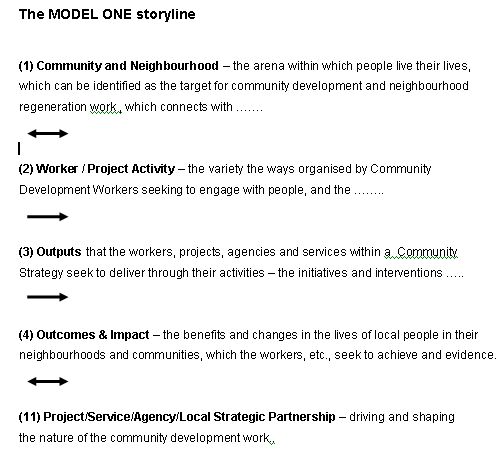
MODEL ONE – A common model for community development working with local people (without a clear community learning component)

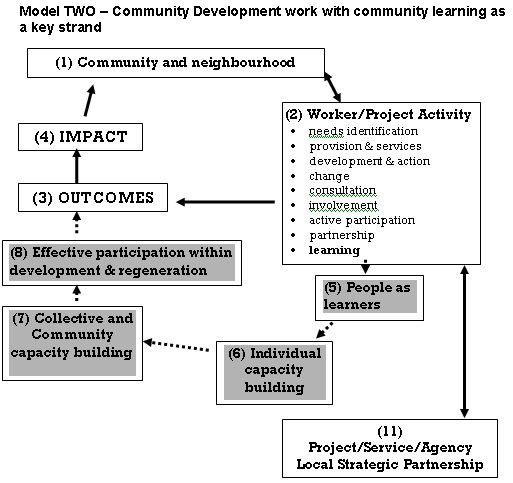
The MODEL TWO storyline
(1) Community and Neighbourhood – the arena within which people live their lives, which can be identified as the target for community development and neighbourhood regeneration work , which connects with (2) Worker / Project Activity – the variety the ways organised by Community Development Workers seeking to engage with people, leading to (3) Outputs that the workers, projects, agencies and services within a Community Strategy seek to deliver through their activities – the initiatives and interventions which deliver (4) Outcomes & Impact – the benefits and changes in the lives of local people in their neighbourhoods and communities, which the workers, etc., seek to achieve and evidence.
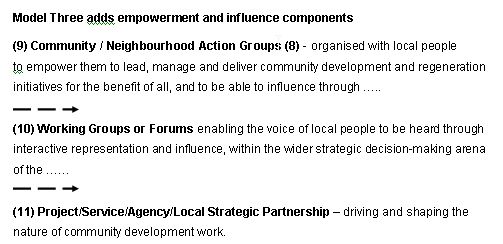
(11) The Project/Service/Agency/Local Strategic Partnership – drive and shape the nature of the community development work.
In addition, this model has community-based learning as an essential strand of community development and regeneration work.
MODEL THREE – Active Participation in Community Development through Community Learning (CapacityBuilding)
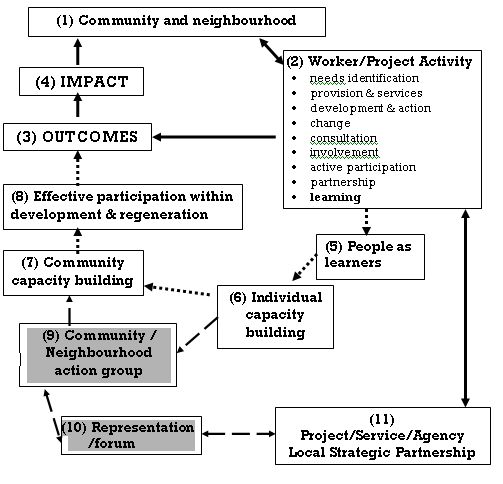
The MODEL THREE storyline
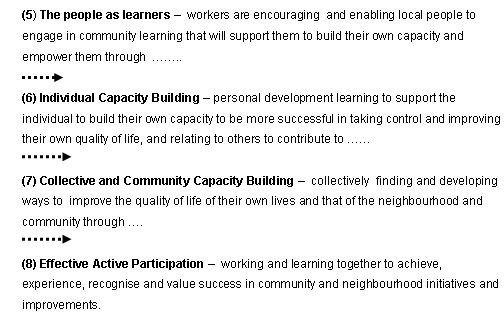
(1) Community and Neighbourhood – the arena within which people live their lives, which can be identified as the target for community development and neighbourhood regeneration work , which connects with (2) Worker / Project Activity – the variety the ways organised by Community Development Workers seeking to engage with people, leading to (3) Outputs that the workers, projects, agencies and services within a Community Strategy seek to deliver through their activities – the initiatives and interventions which deliver (4) Outcomes & Impact – the benefits and changes in the lives of local people in their neighbourhoods and communities, which the workers, etc., seek to achieve and evidence.
(5) The people as learners – local people that workers are seeking to engage in community learning to support capacity building and empowerment, with a concern to encourage and enable them to understand (6) Individual Capacity Building – personal development learning to support the individual to build their own capacity to be more successful in taking control and improving their own quality of life, and to relate to others to contribute to (7) Community Capacity Building – successfully finding and developing ways to collectively improve the quality of life of the neighbourhood and community and (8) Effective Active Participation – then working and learning together to achieve, recognise and value success in community and neighbourhood initiatives and improvements.
The Community Learning within the models
Learning is key to the inclusion and active participation by local people in community development and regeneration.
The community learning is essentially:
- Experiential with people learning from their experiences of life and becoming aware and valuing their own ability to learn and change those experiences
- Experienced by participants within Informal and non-formal situations rather than via formal education and training programmes
- Individually learner-centred rather than driven by an external curriculum, where the learning is relevant to an individuals needs and wants and is transferable and applicable within their daily life
- Holistic – focused on whole person development, concerned not so much with outcomes about what is learnt but with how the individual feels
Community development workers have a role as informal educators or facilitators of learning that enables and supports people, individually and collectively, to develop their own capacity for change in themselves; their lives; their neighbourhoods and communities
Community learning seeks to:
- Support people to change and choose to move from dependency to independence
- Ensure that community development and regeneration changes are sustainable through people action and ownership
- Move work with communities and neighbourhoods from the delivery of provision and service inputs to sustainable action and change – impact underpinned by the capacity of local people.