Community Learning Development Resource 103-08
COMMUNITY LEARNING – MAPPING PROGRESSION
SUMMARY
This resource maps the progression routes that individuals may take in their learning journeys.
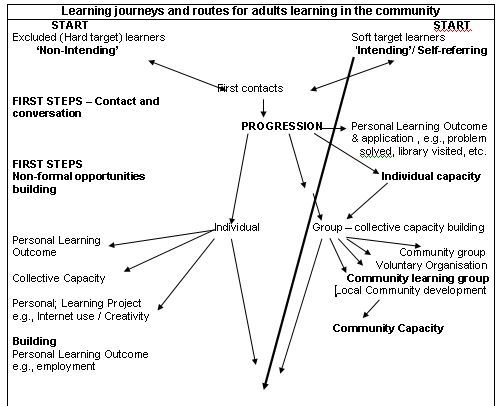
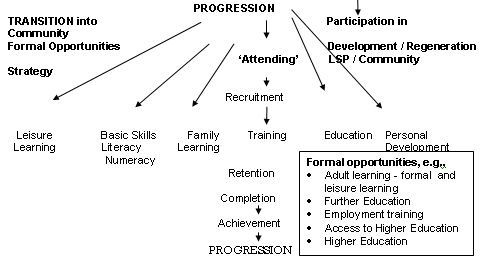
PROGRESSION MAP EXPLAINED …..
The map looks complicated but in reality the situation is much more so. Adult learners are individuals and their own needs and hopes are very varied, so that they can have lots of different learning goals and they take a variety of learning journeys.
Starting points
We recognise that some adult learners are ready and able to learn in formal situations – they are ‘intending learners’.
On the other hand, some ‘non-intending learners’ may not even realise that they can and do learn, and are far from being able to choose a learning route – these are the excluded / disadvantaged / oppressed (‘hard-to-reach’) and they often need personal support and help to begin to gain learning confidence.
First steps
All the community-based contact and non-formal learning opportunities, which many of us engage in – through community development and regeneration work, community groups and ‘learning in the community’ development work.
Many learners will not progress into more formal learning opportunities – through transition, if their learning needs are satisfied and they choose not to progress.
Transition into formal learning may be made by confident intending learners, directly from their starting points. They are confident to choose to go along to colleges and centres, etc., to enrol or self-refer.
Other less confident learners (‘non-intending’ learners) may need further help and support to get to a point where they are comfortable to make the transition into formal learning provision.
Excluded non-intending learners, will by definition, need the most support and time and for some this may take years, rather than hours or weeks, of engaging in non-formal community-based learning.
THE MORE COMPLICATED MAP
The map does not show that learners ‘stop and start’ and even reverse their learning routes, going back to an earlier point before moving forward again. The learning journey for most learners is not continuous and may be along several routes at once.
Example: an individual joins a sports club in the community and gets interested in learning their skills. Later this learner becomes involved in community action and learns from that experience.
Loss of a job means re-training. Getting a new job opens up another possibility for further learning, to gain a qualification and opportunities to be up-skilled. Meanwhile having a family offers other opportunities for learning around parenting and childcare and later, ‘keeping up with the children’.
- The progression map is complicated and serves also to explain why the progression framework is more like a climbing frame than a ladder!
- The progression map confirms the need for workers, agencies and providers to work together, in order to enable learners to make learning choices and progress successfully.
PROMPTS FOR REFLECTION AND DISCUSSION
- Where are you and your organisation on the map and what do you do, to support learning and learner progression?
- What is the significance of your role and that of your agency in encouraging and supporting learner progression?