Community Learning Development Resource 100 – 07
MASLOW’S HIERARCHY OF HUMAN NEEDS
SUMMARY
Abraham Maslow’s insight provides an explanation of a link between a hierarchy of human needs and the motivation to learn. It suggests that there are levels of needs and where until the more basic, fundamental needs are satisfied, it is difficult for higher ones to be addressed. Self-actualisation, as he called it, is the highest motivation, but before a person can turn to it, he or she must satisfy other, lower needs and motivations, like hunger, safety and belonging. This resource (100 – 07) presents Maslow’s model and explores its significance in community learning.
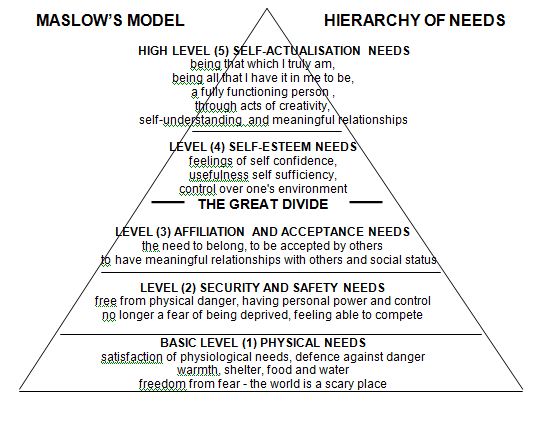
MASLOW’S HIERARCHY MODEL HAS FIVE LEVELS.
1. Physiological needs – hunger, thirst, shelter, sex, etc.
2. Safety needs – security, protection from physical and emotional harm
3. Social needs – affection, belonging, acceptance, friendship
4. Esteem needs (also called ego) – the internal ones include self-respect, autonomy, and achievement, and the external ones include status, recognition and attention.
5. Self-actualisation needs – having the capacity to be creative and fully active.
Maslow points out that the hierarchy is dynamic; the dominant need is always shifting. For example, the musician may be lost in the self-actualisation of playing music, but eventually becomes tired and hungry so he or she has to stop. Moreover, a single behaviour may combine several levels. For example, eating a meal can be both physiological and social.
The hierarchy does not exist by itself, but is affected by the situation and the general culture. Satisfaction is relative. Finally, he notes that a satisfied need no longer motivates. For example, a hungry man may be desperate for food, but once he eats a good meal, the promise of food no longer motivates him.
Empirical (scientific) research has confirmed the first three levels, but has not done so for the fourth and fifth levels of esteem and self-actualisation.
Some other scientists have noted that Maslow’s hierarchy follows the life cycle. A newborn baby’s needs are almost entirely physiological. As the baby grows, it needs safety, then love. Toddlers are eager for social interaction. Teenagers are anxious about social needs, young adults are concerned with esteem and only more mature people transcend the first four levels to spend much time self-actualising.
THE IMPLICATIONS OF THE MASLOW HIERARCHY IN RELATION TO PEOPLE AND THEIR INDIVIDUAL CAPACITY TO LEARN
Examples of what the Maslow model may help to explain:
1. The difficulties and challenges faced by non-confident, non-self-referring people as learners who do not generally enrol themselves into formal education and training programmes within institutions.
o They may not feel safe and secure
o They may need a friend to accompany and support them
o They may feel inadequate and low in self-esteem.
2. Why written materials – leaflets, brochures and flyers for activities, events and programmes do not connect effectively with non-confident people in the community.
o For many the safe and secure way of finding out about new possibilities is by word of mouth from someone they trust
o The written material does not clearly address their fears about what experience will be like – difficult; unfriendly; competitive; costly; new; different; a challenge; threatening.
3. Why many non-confident people need to progress through supported informal and non-formal learning experiences, until they are ready to choose to progress into formal education and training programmes.
o They need to be supported to gain self-esteem and self-belief
o They need to be encouraged to feel safe, confident and non-threatened – they fear the unknown
o They need to learn that they can be successful and to feel confident to make choices.
4. Why non-confident and inexperienced people recruited into formal education and training programmes are more likely to drop-out.
o They are unprepared for the formality and feel unsafe and inadequate
o New and unknown situations and experiences frighten them
o Fear of failure makes them feel insecure.
5. The importance for a worker of being learner-centred and focused on the needs of the individual learner.
o To recognise their individuality, their needs and where they are at
o To build a supportive relationship with each learner based on care, trust, and mutual respect
o To be able to relate to and to seek to address individual needs, at whatever level
o To provide individual confirmation of learning success and of the needs being addressed.
6. Why we should be making much greater efforts to widen participation and enable excluded adults to gain from learning?
o To address the needs of adults as learners, whose needs are fundamental and below Maslow’s ‘Great Divide’
o To address situations where their needs are barriers to their participation in learning and contribute to their exclusion.
7. How learning success and learning progress can enable individuals to cross Maslow’s Great Divide.
o They gain in self-esteem and status – they feel good
o They can reflect on positive learning experiences and relationships
o They understand that they have learnt successfully and value their success, the experience and the outcomes.
EXAMPLES OF IMPLICATIONS OF MASLOW, FOR PEOPLE AND FOR US WHEN WE ENGAGE THEM IN ACTIVITIES?
1. Physiological needs not met
- A poor quality environment can constrain activity success.
- Some people after a day’s work find it difficult to concentrate – without having a meal. There is a time when blood sugars get very low and when refreshment is needed.
- Adults exercising need to drink water to avoid dehydration.
2. Security needs not met
- Physical security – a safe learning environment, Health and Safety procedures followed in the use of equipment – physical security.
- Emotional security – not having to worry about the child-care provided for your child.
3. The need to belong
- If an individual in a group feels isolated and hasn’t been helped to connect with others – even if their needs for warmth, physical and emotional security have been met, the personal growth which comes through learning will be much harder to achieve.
4. Self-esteem and self-image needs
- Many excluded and non-confident people enter new situations very warily, having been damaged by previous experiences. Unless the worker encourages them and connects with their strengths and achievements as individuals, they may not engage and may give-up.
5. Self-actualisation
- Individuals can become successfully creative and can develop creative solutions to problems
- People become empowered through successful learning so that they can take control of their own lives.
- Dependent people become independent.
Abraham Maslow
Understanding Human Motivation
A member of the Chicago dynasty of psychologists and sociologists, Abraham Maslow published his theory of human motivation in 1943. Its popularity continues unabated. Like his colleague Carl Rogers, Maslow believed that actualisation was the driving force of human personality, a concept he captures in his 1954 book, Motivation and Personality.
“A musician must make music, an artist must paint, a poet must write, if he is to be ultimately at peace with himself. What a man can be, he must be.”
REFLECTION AND DISCUSSION PROMPTS:
- Think of individuals that you work with and the nature of any of their needs, which interfere with their ability to gain from learning success. How might you overcome the difficulties?
- Is the concept of the learner’s comfort-zone a helpful one in trying to support people to gain from successfully learning?
- Is there a need for workers to plan for learning environments and activities, that are ‘learner-friendly’?
- Think of people you work with who have a range of needs – have you provided a ‘learner-friendly’ environment and how has it worked successfully?